Climate Predicts Alcohol
Wines from hot regions are usually stronger than wines from cool regions.

Understand Wine. Enjoy Every Glass.
Wine Basics
Most wine lands between 11% and 15% alcohol, but the spread from a fizzy Moscato to a glass of Port is huge. Here is what the numbers mean and why they matter.
Start Learning
Wine alcohol content is measured as alcohol by volume, or ABV. A wine labeled 13% ABV is 13% pure alcohol and 87% everything else, mostly water. Most still red, white, and rosé wines fall between 11.5% and 14.5%. That is roughly two to three times the strength of a typical beer and well below spirits, which usually sit around 40%. Within that range, small differences matter more than they look. A 14.5% Zinfandel has about a quarter more alcohol than an 11.5% Vinho Verde, so a glass of one is noticeably stronger than a glass of the other. Alcohol also shapes how a wine tastes and feels. Higher alcohol adds weight and warmth, which is a big part of wine body, while lower alcohol tends to feel lighter and fresher.
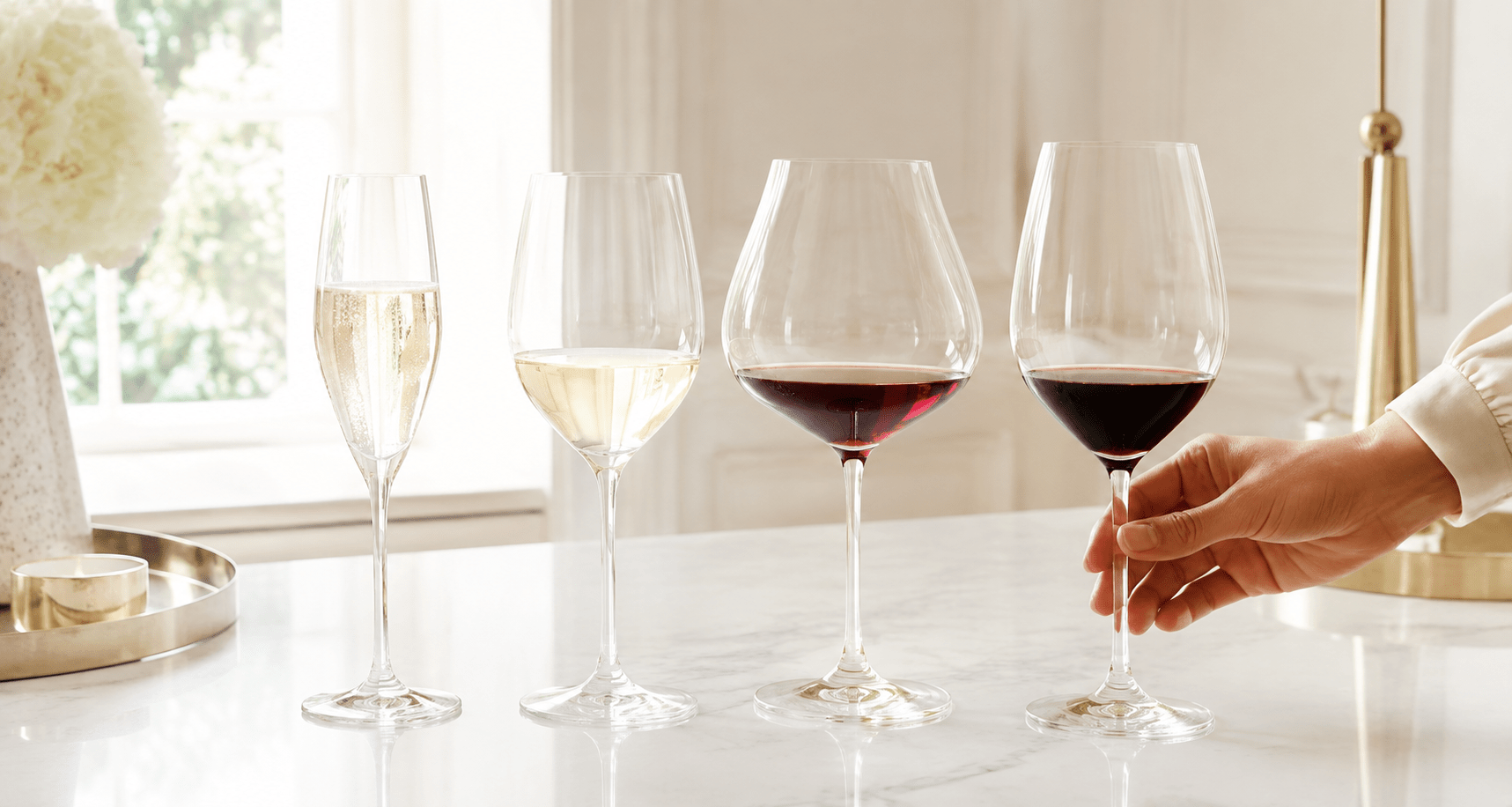
Alcohol comes from fermentation. Yeast eats the sugar in grape juice and turns it into alcohol and carbon dioxide, as explained in how wine is made. More sugar in the grapes means more potential alcohol. That is why climate matters so much. Sunny, warm regions such as California, southern Australia, and southern Spain ripen grapes fully, giving more sugar and higher alcohol. Cool regions such as the Mosel, Champagne, and the Loire Valley produce leaner grapes and lighter wines. Harvest timing plays a role too, since grapes picked later carry more sugar. Finally, the winemaker can stop fermentation early, leaving natural sweetness and less alcohol. Many sweet wines, including Moscato d’Asti, are made this way, which is why they can be both sweet and very low in alcohol.
Low (under 11%): Moscato d’Asti, German Riesling labeled Kabinett or Spätlese, Vinho Verde, and some Lambrusco. These are often off-dry and refreshing, and our low-alcohol wine page has more options. Moderate (11–13.5%): Most Pinot Grigio, Sauvignon Blanc, Champagne, Chablis, Beaujolais, red Burgundy, and Chianti. High (13.5–15%): Most California Cabernet Sauvignon and Chardonnay, Argentine Malbec, Australian Shiraz, and Châteauneuf-du-Pape. Very high (15%+): Ripe Zinfandel, Amarone, and some Grenache-based reds. Fortified (15–22%): Port, Sherry, and Madeira, where neutral grape spirit is added to raise the strength. These are typical ranges. Individual bottles vary by vintage and producer, so the label is always the final word.
Almost every bottle lists ABV on the front or back label, as covered in how to read a wine label. The number is useful, but it is not exact. In the United States, wines at 14% ABV or below may legally vary by up to 1.5 percentage points from the stated figure, and wines above 14% by up to 1 point. A bottle labeled 13.5% could really be 14.5%. Other countries have their own tolerances, usually tighter. Use the number as a reliable guide to style rather than a precise measurement. As a rule of thumb, anything under 12.5% will feel light and crisp, while anything above 14% will feel rich, ripe, and warming.
In the United States, one standard drink contains about 14 grams of pure alcohol. For wine at 12% ABV, that is a 5-ounce pour. A standard 750 ml bottle holds about five of those pours. The higher the ABV, the smaller a standard drink becomes. A 15% Zinfandel reaches one standard drink at roughly 4 ounces, and a 20% Port at about 3 ounces, which is why fortified wines come in small glasses. Restaurant and home pours are often larger than 5 ounces, especially in big-bowled glasses, so it is easy to underestimate how much you are drinking. If you want to keep track, measure a 5-ounce pour once at home to see what it looks like, and check our tips on how to pour wine.
Wine is for adults 21 and over, and alcohol affects everyone differently based on body size, food, medications, and health. Alternating wine with water and eating while you drink both slow how quickly alcohol builds up. Choosing a lower-ABV style is an easy way to enjoy a few glasses over a long meal with less total alcohol. Never drive after drinking. If you have questions about how alcohol fits with your health, pregnancy, or any medication, talk with your doctor. For a completely alcohol-free option with a similar feel, explore non-alcoholic wine, which has come a long way in recent years.
Look on the front or back label for a percentage followed by 'alc/vol' or 'ABV.'
Under 12.5% is light, 12.5–14% is moderate, and over 14% is high for table wine.
Remember that US labels can be off by up to 1.5 points for wines at 14% or below.
Pour about 5 ounces of a 12% wine for one standard drink, and less for stronger wines.
Choose a crisp white or light red under 12.5% when you plan to sip for hours.
| Wine Style | Typical ABV | Examples |
|---|---|---|
| Light and sweet | 5–9% | Moscato d'Asti, Riesling Kabinett |
| Light whites and sparkling | 9–12% | Vinho Verde, Muscadet, Champagne |
| Medium whites and reds | 12–13.5% | Sauvignon Blanc, Pinot Noir, Chianti |
| Full-bodied reds and whites | 13.5–15% | Cabernet Sauvignon, Malbec, oaked Chardonnay |
| Very ripe reds | 15–16% | Zinfandel, Amarone |
| Fortified wines | 15–22% | Port, Sherry, Madeira |
Wines from hot regions are usually stronger than wines from cool regions.
Pour 5 ounces into your usual glass so you know what a standard drink looks like.
A slight chill to 60–65°F keeps high-alcohol reds from tasting hot.
Learn Your Taste
Answer a few simple questions and discover styles that fit your palate.
Take the Wine QuizFortified wines like Port, Madeira, and some Sherries are the strongest, often 17–22% ABV, because grape spirit is added. Among unfortified table wines, ripe Zinfandel, Amarone, and some Grenache reds can reach 15–16%.
ABV stands for alcohol by volume, the share of the liquid that is pure alcohol. A wine labeled 13% ABV is 13 percent alcohol. Labels are allowed a small tolerance from the true figure, so treat the number as a close guide rather than an exact measurement.
It is on the higher side for table wine but very common for California Cabernet, Malbec, and Shiraz. Wines at 14% feel full-bodied and warming. Anything above 15% is considered very high for an unfortified wine.
Often, but not always. Many reds come from riper grapes and land at 13.5–15%, while many whites sit at 11–13%. A Napa Chardonnay can easily be stronger than a red Beaujolais, so always check the label.
A 5-ounce glass of 12% wine holds about 0.6 ounces, or 14 grams, of pure alcohol, which is one US standard drink. A bigger pour or a stronger wine contains proportionally more.
No. Alcohol content is set when fermentation ends and stays essentially the same in the bottle. An older wine may taste softer or less alcoholic as its fruit and tannins evolve, but the ABV does not rise.